
EasySpecs Labs

Build working agent loops on your repository in 1–2 days.

The hands-on format most teams start with: your engineers build layered context, review rituals, and agentic coding workflows directly on your codebase — led as serious engineering work, not generic tool tips.

  • €4,995
  • 1–2 days

Business outcome

Merge throughput rises because the whole team rehearses the same repo-native context, rules, and verification rituals — agent output scales with your cadence instead of resetting every quarter when models or IDEs change.

What you leave with

  • 1–2 calendar days on your codebase and toolchain
  • Working agent loops, MCP wiring, and a starter playbook checked into your repo
  • Context engineering foundations and SDLC agents your team deploys immediately
  • Human-led verification on merge-worthy work — one professional bar for the whole team
  • Product and design context exercises so agentic engineering does not stop at the IDE
  • Written playbook and implementation notes versioned like any other change

Workshop curriculum

Workshop curriculum — your repository

Four modules on the same spine as our public agentic coding curriculum — adapted to your stack, compliance, and review bar. Every exercise ships merge-worthy artifacts in your repo.

Browse full topic catalog (EB-1 … EB-11)Every EasySpecs Content Block and topic — combine ad hoc for your program (no fixed public duration).

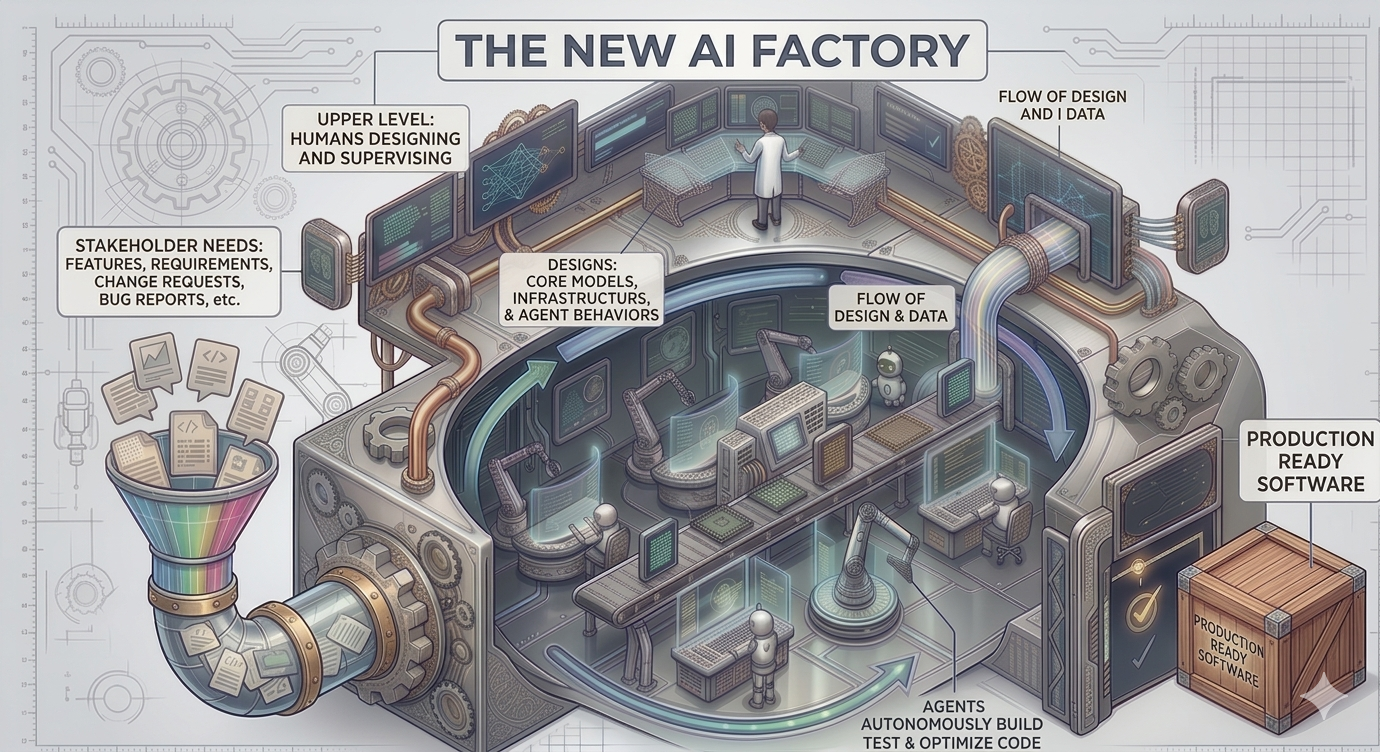
AI factory pattern: production line and workstation

We frame serious agentic coding with industrial metaphors you can teach and repeat. Together they describe a non-interactive way of working: you spend your time hardening how software is produced, not hand-authoring every variant of the product.

Infographic contrasting human-led development with an AI factory: structured intent feeds specialized agent workstations in an iterative loop, then quality checks, ending in production-ready delivered software.

AI factory design pattern

In AI-assisted development, the factory is what you version next to the code: rules, MCP tools, sub-agents, policies, and verification hooks that manufacture artifacts—patches, tests, migrations, docs—from structured intent. You implement and review the factory; the factory implements the feature-shaped output.


Production line

The production line is the ordered pipeline through your workstations: each step declares inputs and outputs (for example story → technical plan → patch → tests → human gate). Because the sequence is explicit, you can re-run the same line when priorities change and still land production-ready diffs.

Workstation

A workstation is one narrow station on the line: a scoped agent run with its own prompt pack, tools, and acceptance checks—generate contract tests for this module, refactor under these invariants, summarize this delta for reviewers. Small blast radius, inspectable results.

Non-interactive delivery and changing scope

Instead of “chat until it looks right,” teams invest in factories and lines that run with minimal babysitting—closer to a build than a conversation. When feature scope shifts, you do not chase the old hand-written path: you adjust factory inputs or a workstation, then repeat the process so the line emits a new production-ready solution. That is how delivery speed and flexibility compound as requirements move.

  • Context engineering foundations

    Your infrastructure makes any AI tool work reliably. Your multi-layer context architecture becomes your foundation. Your product teams structure domain knowledge as AI context. Your developers configure tools, MCPs, and sub-agents for consistent results. Your configurations are documented, customized, and ready to deploy immediately.

  • Agents for every development phase

    Your agents work through every development phase. Your POs produce complete specs from user stories. Your planning catches dependencies early. Your implementation follows standards consistently. Your reviews identify improvements systematically. Your legacy migrations gain momentum. Every phase becomes coordinated.

  • Team practices & change management

    Your entire team transforms how they work together across development and product roles. Your practices refine sprint by sprint. Your team recognizes when to adapt agents and discovers new patterns. Your custom playbook and 90-day checklist guide your next steps.

  • Architecture & quality at scale

    Your patterns work brilliantly with AI. Your complex systems simplify into clear boundaries agents understand. Your APIs eliminate ambiguity. Your documentation feeds context naturally. Your architecture becomes the foundation that makes AI reliable, not a constraint.

Key metrics

  • Investment: €4,995 · 1–2 days · up to 15 participants
  • Conservative payback: ~2 weeks of recovered review and rework time
  • Year 1 ROI (conservative): 10×–25× vs. workshop cost
  • Delivery: on-site or remote · artifacts land in your repository

When to use this program

When you want proof on your stack before a longer immersion, or when engineering leads need a fast, repo-native win leadership can fund without a four-week engagement.

Conservative ROI scenario

Two weeks to pay back a €4,995 workshop

Conservative scenario: a team of eight engineers each saves three hours per week on review churn and context rebuilds after shared agent rituals land in the repo — roughly €4,995 equivalent in the first fortnight at typical loaded rates, then compounding each sprint.

Agentic Coding Coaching

Workshops are coached by senior EasySpecs practitioners — product, structured requirements, and platform architecture at the table with your team, not junior facilitators reading slides.

  • Portrait of Xesca Alabart, EasySpecs Labs coaching lead

    Xesca Alabart

    Lead coach — product & requirements · CEO, EasySpecs

    Xesca combines product leadership with requirements engineering, helping teams turn business intent into explicit objectives and acceptance signals agents can work against—not vague chat prompts. She facilitates mixed rooms of engineering, product, and design while keeping a sharp definition of what “done” means.

    • Aligns engineering, product, and design without diluting technical depth
    • Brings structured requirements practice into AI-assisted delivery
    • Based in Barcelona; delivers in English, Spanish, or Catalan as needed
    LinkedIn
  • Portrait of Carlos Guirao, EasySpecs Labs coaching lead

    Carlos Guirao

    Carlos Guirao Capistany

    Lead coach — platform & agent workflows · CTO, EasySpecs

    Carlos architects EasySpecs’ platform and AI systems with an emphasis on safe, reviewable change in mature codebases. He focuses on boundaries, APIs, and verification so agentic engineering produces diffs your team can trust—not opaque churn.

    • Systems and integration architecture for complex products
    • Hands-on with agent workflows, tools, and how they land in your repository
    • Leads the technical spine behind Application Mapping and agent-ready context
    LinkedIn

FAQ

Do product and design participate?

They join for context exercises where it helps. Engineering owns implementation depth; product and design focus on upstream intent so agents pull one source of truth.

Will this be obsolete when models change?

Models will change; verifiable context, explicit objectives, and disciplined review will not. We teach durable habits behind agentic coding so your team can swap tools without restarting from zero.

What happens after the last workshop day?

You keep every artifact in your repository — prompts, rules, checklists, notes. We include a focused wrap-up conversation and written recommendations. Control Plane at Scale (€7,995) is a typical next step when orchestration and governance must scale org-wide; Context Engineering & Token Optimization (€4,995) follows in Optimize when token and context economics become the bottleneck.